|
 |
|
BiosBiosBiosBiosBiosBiosBiosBiosBiosBiosBiosBiosBiosBiosBiosBiosBiosBiosBiosBiosBiosBios |
|
| |
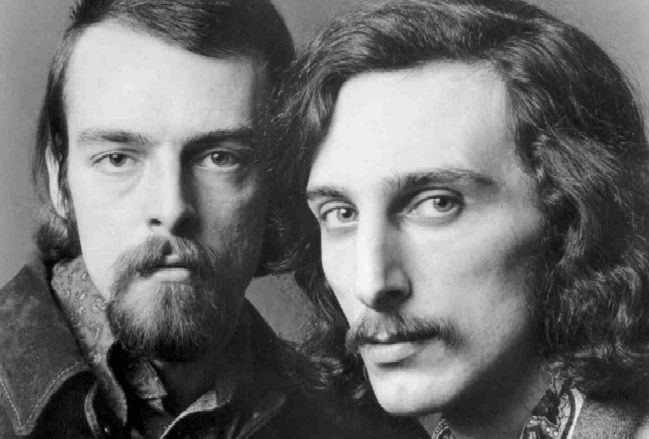
photo: Jim
Goss |
|
| |
MICHAEL BREWER & TOM SHIPLEY
began
their careers as solo folk artists on the coffee house circuit in the early
1960s. Both native mid-westerns (Oklahoman and Ohioan respective to
their billing), they first met in 1964 at the Blind Owl coffee house in
Kent, Ohio. It would be three more years before they would team up,
and during those three years the two crossed paths at
clubs on the folk circuit, and each tried their hand in other musical
collaborations
that didn’t pan out. |
|
| |
|
|
| |
DOWN IN L.A. |
|
| |
In 1965
Michael Brewer migrated to Los Angeles following the emerging west coast
music scene. His initial duo
Mastin & Brewer
signed a record deal with Columbia Records but after the group imploded
before finishing their record, Brewer eventually accepted a job as a staff songwriter
at
Good Sam Music,
a publishing offshoot of the newly formed A&M Records. Around this
time, Tom Shipley arrived in
L.A.
and looked up his acquaintance from the folk circuit. Tom rented a house around the corner from Michael’s
house, and soon they began writing songs together. When
Shipley was subsequently hired as staff writer for A&M in 1967, their partnership
began as a songwriting collaboration.
 |
As staff
songwriters, their
early songs
were recorded by The Nitty Gritty Dirt Band,
Glen Yarborough,
H.P. Lovecraft, The Poor, Noel Harrison, and Bobby Rydell. A&M Records soon recognized that Michael & Tom’s demo
recordings exhibited a unique sound and style of their own, so they
green lighted them to record an album. A&M brought in the
best musicians in the L.A. to play on the album. But even with a
soon to be released debut album and
mutual
friends who were starting to make it big
in bands such as The Byrds,
Buffalo Springfield, and The Association,
Michael and |
|
|
| |
Tom
so disliked their life in
L.A. that
they decided to move back to the
Midwest as soon as the record was recorded. |
|
| |
|
|
| |
GOOD KARMA IN THE HEARTLAND |
|
| |
By the
time their debut album
Down In
L.A.
was released by A&M in October 1968, Brewer & Shipley had settled in Kansas
City, Missouri.
Tom described their decision to settle in Missouri as one of
fortunate circumstance. "There was a music scene built up in Kansas City,
and Michael and I used to come during Christmas and it was great. There
would be clouds in the sky -- you don't see clouds in LA, just the haze.
"We
really didn't care for
L.A.
very much," explained Michael. "We had just had enough, and figured there
had to be a better way to make music, without living there. So we left
California, and ended up coming back to the heartland. We ended up in Kansas
City and started a management/production company with some friends,
Good Karma Productions.
"Our
management went to the east coast to shop some labels. Buddah signed us,
because Neil Bogart (Buddah President) at the time was known as the king of
bubblegum -- you know, 1910 Fruitgum Company and all that stuff. He was
trying to shatter that image, and looking for album artists. And that's what
Tom and I were. We were never about singles. Every song on our albums was
just as important as the next one. All of our albums, we meant to be whole
packages." |
|
| |
|
|
| |
ALBUM ARTISTS |
|
| |
|
And Neil
Bogart was right, Brewer and Shipley were album artists who subsequently
recorded for four different
labels, A&M Records, Buddah Kama Sutra Records, Capitol Records, & their own
One Toke Productions. Their greatest commercial success was with Kama
Sutra where they released four albums in the space of four years: Weeds, Tarkio, Shake Off The
Demon, and Rural Space. After leaving Buddah Kama Sutra
they were signed by Capitol Records where they
released two albums in two years on Capitol: ST11261 and Welcome
To Riddle Bridge. Since reuniting in 1987, they have released two albums on their own One
Toke Productions label: Shanghai & Heartland.
The
musicians
who appeared on Brewer & Shipley albums are literally a who's who of
musicians. |
| |
|
|
| |
ONE TOKE OVER THE
LINE |
|
| |
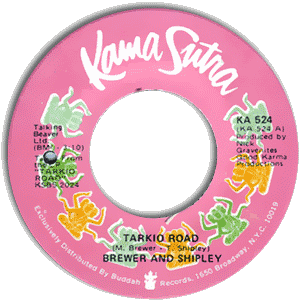 |
“One Toke
Over The Line” on, their third album, Tarkio
immediately connected with the record buying public and became a Top Ten Hit
in 1971. It took Brewer & Shipley on quite a roller coaster
ride that year. Just as it was peaking on the charts,
the Vice President of the United States,
Spiro Agnew labeled
Brewer & Shipley subversive to America’s youth and then strong-armed the FCC to
pull “One Toke Over The Line” from the airwaves. They made |
|
Nixon’s
infamous "Enemies List," a badge of honor which they continue to
wear proudly today. They couldn't have paid
for that kind of publicity and they ended up playing their counter culture hit
song on several
national television shows in the US, Canada, and the UK. In the early
70s not
everyone knew what the word toke meant and additionally many misinterpreted their iconic
song because of the "sweet Jesus"
lyrics. This probably accounted for several country artists
recording "One Toke" in
1972
and was definitely responsible for "One Toke Over The Line" being covered on the
Lawrence Welk Show. “One
Toke” became a classic rock anthem, but Brewer &
Shipley wrote the song tongue-firmly-in-cheek. Michael
explained, "We had been songwriters for so long that it was just
another song for us. It wasn't even one of our favorites. We
always thought our ballads were our better songs.
Other people chose to make a big deal out of it. We were really
happy just to get a hit, even if it wasn't necessarily the one we
would have picked. We're really glad people still like it."
|
|
|
| |
|
|
| |
CONSUMMATE LIVE
PERFORMERS |
|
| |
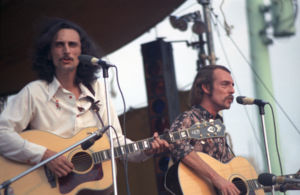 |
While
crafting wonderful albums with some of the best musicians in the world
backing them, Brewer & Shipley were always at their best
as live performers. Whether with a small backing band, or more often
by themselves with just their two acoustic guitars, the duo was constantly touring
from 1969 to 1979. They played all over the country including in such notable
venues as Carnegie Hall, The Bottom Line, The Troubadour, The Roxy, Keil
Opera House, and Arrowhead Stadium. |
|
Because of
their broad appeal, they became a favored support act for major
tours, and
shared the stage with a diverse list of artists, including:
Elton John, The Eagles, Bruce Springsteen, Billy Joel, Bonnie Raitt, Electric Light Orchestra, Blood Sweat
& Tears, James Taylor, Stephen Stills, The Beach Boys, Loggins &
Messina, Linda Ronstadt, John Sebastian, and The Ozark Mountain Daredevils among others. |
|
|
| |
|
|
| |
SETTING SAILS AND
CASTING DREAMS |
|
| |
In 1980,
after more than a decade of writing, recording, traveling, and performing,
Brewer and Shipley amicably parted company to pursue separate personal
interests. "There was no big break up," Brewer said. "We'd been on the
road too many years, it almost killed us." "We were burned out," Shipley
agreed.
Michael
continued to make music, recording a solo album for Dan Fogelberg’s Full
Moon Records entitled Beauty Lies (1983). Tom began working as a television
producer/director, eventually forming his own production company Tarkio
Communications. He later founded the Oral History of The Ozarks Project, a
non-profit organization producing documentaries about life in the Missouri
Ozarks. |
|
| |
|
|
| |
ONE KIND FAVOR BRINGS
THEM BACK TOGETHER |
|
| |
|
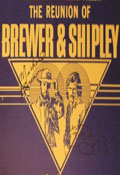 |
In 1987,
at the request of a
Kansas City
radio station, Brewer & Shipley reunited for a concert to celebrate the
station's first birthday. Unsure of what to expect after being out of
the public eye for so long, the duo was overwhelmed as they walked on
stage to over 10,000 cheering fans welcoming their return.
Having come full circle from their days as staff songwriters living in
Los Angeles, Michael and Tom began writing together again. Their first
project was the
soundtrack for one of Tom's documentaries...the award winning, "Treehouse
An Ozark Story". Since reuniting in 1987 Brewer & Shipley have
released two albums
Shanghai
(1993) and Heartland (1997). They continue to perform live shows
as a duo, while also
|
|
continuing their own interests. Recently Tom has retired as
manager of the video department at the Missouri University of Science and Technology, but
he is as busy as ever doing freelance work for the
University and others. He has won several film awards for his
work.
Michael continues to be a prolific song writer, and has released three more solo albums,
Retro
Man (2004), It Is What It Is (2010), Dancing With My
Shadow (2012). |
|
|
| |
|
|
| |
EVERY LITTLE THING WERE
PUTTIN' OUT RETURNS TO US AGAIN |
|
| |
|
In the
last decade-plus, the duo has witnessed rejuvenated interest in their
music, beginning with BMG's purchase of their Kama Sutra catalog and
subsequent re-issue of the critically acclaimed Tarkio release in
1996.
This was soon followed by the inclusion of "One Toke Over The Line" on
the Fear And Loathing In Las Vegas motion picture soundtrack. A
live record of classic performances from 1973, Archive Alive, was
released in 1997, the same year they released an album of new material
Heartland on their own One Toke Productions label. The duo also
contributed guest vocals on their trademark song “One Toke Over the
Line” on the 1998 Rainmakers cover of their hit for the Hempilation
II (Free The Weed) CD. That was followed by BMG’s release of
Best of Brewer & Shipley: One Toke Over The Line in 2001, and
Collectors Choice/BMG’s release of a twofer CD of their first two
classic Kama Sutra albums Weeds & Tarkio, in 2004.
The Weeds & Tarkio twofer was repackaged and released by Acadia
Records (UK) in 2008. Their long lost debut LP Down In L.A. was finally released on CD
in 2012. |
|
|
| |
 |
|
| |
LAST
OF THE HIPPIES? |
|
| |
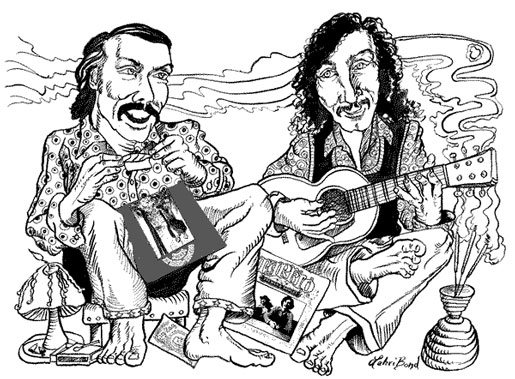
"I never considered myself a hippie,"
commented Michael. "I was a young, married man paying taxes, working,
pursuing a career. I wore the clothes of the time and had long hair -- back
when I had hair -- but I never lived in a commune. I actually bathed and
shaved."
Tom, however, had no problem with the label. "Back in the days when
we were officially card-carrying hippies traveling cross-country and living
out of our Volkswagen," he says, "I spent some time on a Hopi
reservation out in the middle of Arizona. But I did not take acid and go
running naked through any of their pueblos. And I bathed."
Nevertheless, Tom is aware of the legacy and chalice they carry, laden with
the fragrance of long ago. "We were playing the Catskills a few years ago,"
he recalls, "and this beautiful girl comes gliding across the floor, just
glowing. She comes up to Michael and takes his hand and clutches it toward
her chest. 'You guys,' she says, 'are the last of the hippies. When you're
gone there won't be any more.'"
But don't
despair just yet, Brewer & Shipley are still kicking and have a new
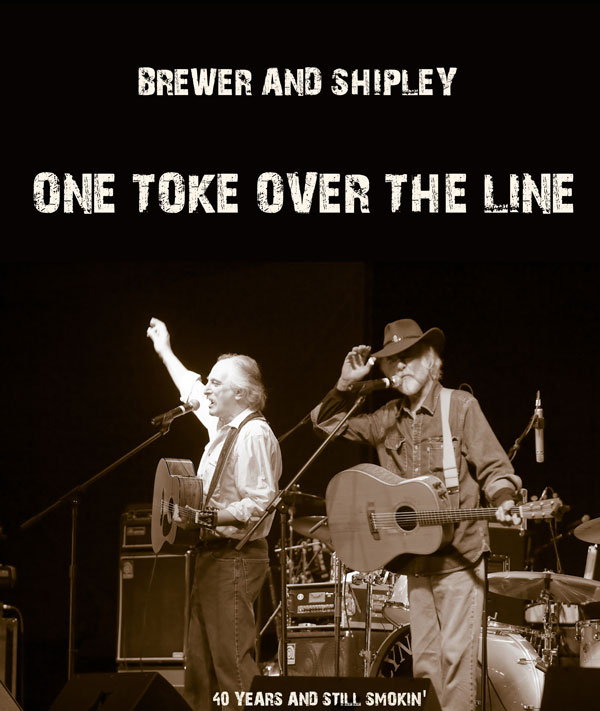
motto "40
Years and Still Smokin'."
They
continue to do what they have always loved, perform for audiences, and even
at this stage of their career are adding highlights such as their
performance in 2010 with Levon Helm at his Midnight Ramble in Woodstock. You can
find their current show schedule on our
Shows
page or find their digital releases on our
Store
page. |
|
| |
|
 |
|
|
|
Bios |
|